things changing in 2027 that your setup can’t handle
Your 2027 plan is probably a 2026 plan with bigger numbers.
That’s how most of them get written. It's the same channels, same flows, same split between paid and owned with a growth target stuck on top.
We're giving you six things are actually changing next year. Two of them have dates attached, three are already live and nobody has adjusted, and one is a forecast that’s worth taking seriously anyway.
Each one below has the thing to do about it before January. 👇
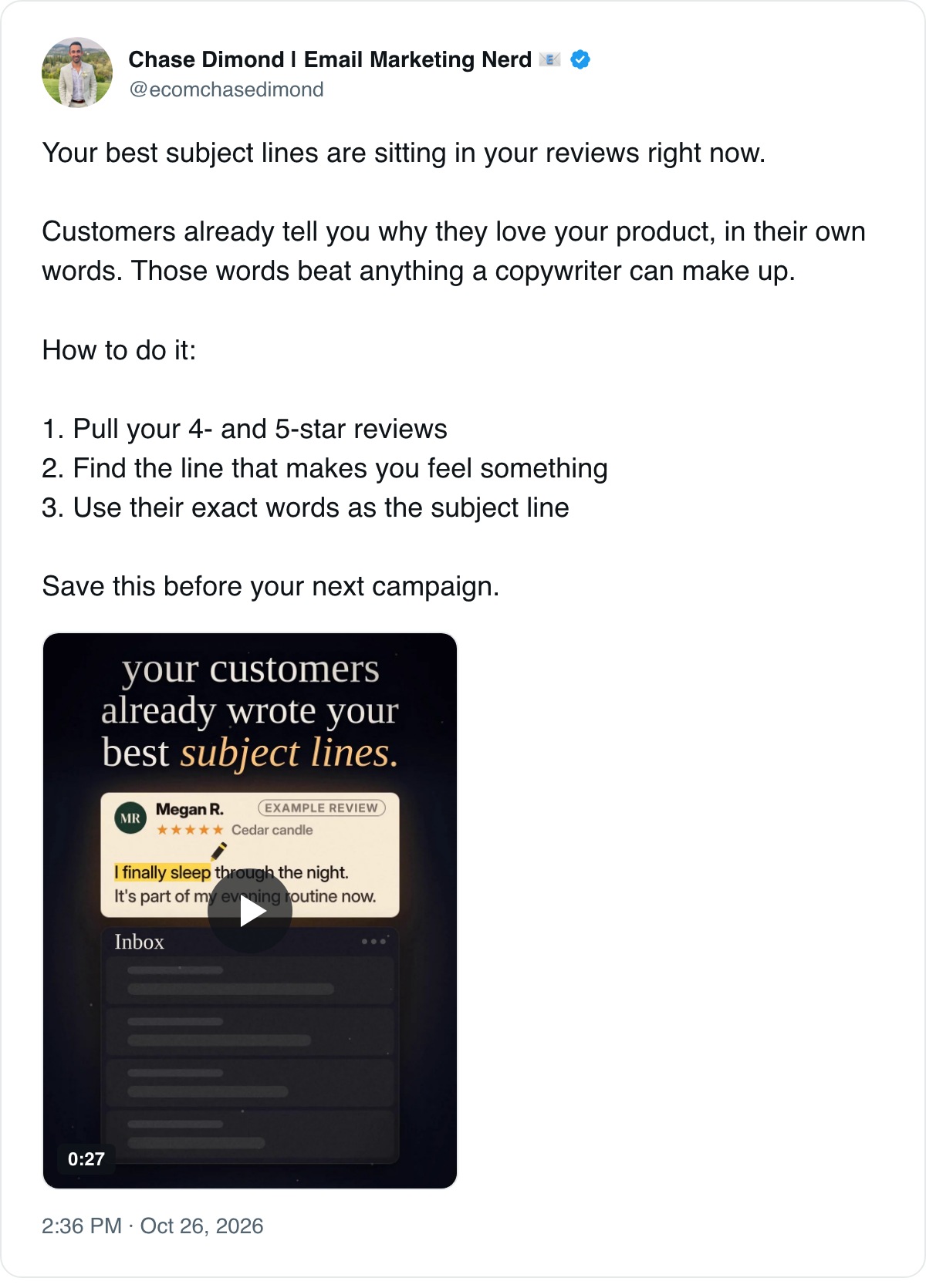
Your best subject lines are already written
Chase posted this on Monday. It’s the cheapest subject line exercise there is, so here it is in full. → See the original post
6 shifts landing in 2027, and what to do about each before January
One note on sourcing before the list, because every inbox fills up with 2027 predictions this time of year and most of them are a vendor estimating the size of its own market. We’ve split each shift into what’s confirmed and what’s still somebody’s guess. The guesses aren’t worthless. They’re just not budget.
Four of the six have a real date attached.
1. AI agents start doing the buying
Confirmed. You can already buy things inside Google AI Mode, Perplexity, Microsoft Copilot and Amazon’s Buy for Me, assuming the merchant got wired up. BCG asked retailers how they felt about it: 68% expect a significant or transformational effect within two years, 18% are deploying at scale already, and 24% haven’t got past the meeting where someone says we should look into this.
Still a forecast. Which protocol wins. UCP, ACP and AP2 are all being pushed hard, mostly by the companies that built them. Nobody recommending one of them is neutral.
✓ Before January: audit the product feed, because the feed is the storefront now. Complete titles, full attributes, inventory counts that are actually true. Then go find your free shipping threshold and your loyalty terms. If they only exist inside a graphic, an agent lining you up against three competitors can’t see them, and you lose on a detail you’d have won.
2. Email’s share of revenue goes up, for an unflattering reason
Confirmed. Email runs around 27% of DTC ecommerce revenue on average. The brands at the top are pulling 35 to 40%.
Still a forecast. The call that the average passes 30% next year. Fine call, and here’s the uncomfortable bit inside it: that number can go up while your email program gets worse, because it’s a share. If paid falls apart around you, it looks on the dashboard like you had a great year.
✓ Before January: work out your own number. Email revenue as a percentage of total revenue, full year, not campaign ROI and not revenue per send. If you come in under 25%, it’s almost never the campaigns. It’s the three flows nobody enjoys building: post-purchase, winback, and browse abandonment on the collection page rather than the product page.
3. The deliverability floor rises again
Confirmed. Since February 2024, Gmail and Yahoo have wanted SPF, DKIM, an aligned DMARC record, one-click unsubscribe, unsubscribes honored within two days and spam complaints under 0.3%, at roughly 5,000 messages a day. Apple asks bulk senders for SPF, DKIM and DMARC and rejects mail that fails, with no deadline and no published complaint threshold.
Still a forecast. A February 2027 date for Microsoft applying the same bar to Outlook, Hotmail and Live is doing the rounds in vendor writeups. We went looking for it in Microsoft’s own postmaster documentation and couldn’t find it. Plan for it, don’t quote it.
✓ Before January: if your DMARC record still says p=none, start moving. Thirty days at none while you read the aggregate reports and find every service sending as you, and you will find one you forgot about. Thirty days at quarantine on a low percentage. Then reject. Ninety days end to end, and January is a much nicer month to do it than the week a mailbox provider announces a date.
4. Social stops being discovery and becomes checkout
Confirmed. eMarketer has social commerce passing 7.8% of all online sales by 2027. Instagram, TikTok and YouTube increasingly carry the whole path rather than just the top of it.
Still a forecast. Whether any of them ever hands you the customer. Nothing in the last ten years suggests they will.
✓ Before January: decide how a follower turns into an email address, and make it one step instead of three. Link in bio to a landing page to a form is three, and you lose people at every one. Then pick the number: emails captured per 1,000 views. Almost nobody tracks it, which is most of the reason almost nobody improves it.
5. Opt-out signals stop being a legal checkbox
Confirmed. Several states already require you to honor browser-level opt-out signals like Global Privacy Control, which is an engineering job rather than a policy page. Maryland’s sixty day cure period expires April 1st, 2027, so after that a mistake is just a violation. California’s privacy regulator has finalized rules on risk assessments, cybersecurity audits and automated decision-making, phased in over time.
Still a forecast. How hard any of it gets enforced against mid-sized brands.
✓ Before January: two jobs, both short. Open your own site with GPC switched on and watch what the banner does, because plenty of them display exactly the right words and quietly ignore the signal. Then write the list of every tool making an automated decision about a customer: who gets the discount, who gets suppressed, who gets flagged as fraud. That list is what the California rules are about, most brands have never written it down, and it takes an afternoon. It’s the only thing on this page you can finish this week.
6. Channel concentration gets priced
Confirmed. Strategic buyers are still the main exit for DTC brands, and channel concentration is the first risk they price. One channel carrying most of your revenue is a haircut on the multiple whether or not you ever sell.
Still a forecast. Every number anyone gives you about 2027 valuations. Throw out the multiples and keep the diligence question.
✓ Before January: write down what percentage of revenue comes from your single largest channel. If it’s over 50%, the fix takes about a year, which is exactly why it never gets started. In Q1 it isn’t urgent, and by Q3 it’s too late to change anything this year. The cheapest second channel for almost everyone reading this is the one they already own and under-run, which puts us back at number two.
If you only do one of the six, do the DMARC move. Every other item here costs you money slowly. That one stops your email arriving.
Four platform changes landed this month, every one of them with a date on it. These are the kind nobody emails you about and everybody assumes you noticed.
Shopify script tags stop loading on March 1st, 2027
They stopped being created or updated on October 1st. If a pop-up, review widget or tracking pixel went onto your store three years ago, there’s a decent chance it still runs this way. The replacement is an app embed, and it stays switched off until somebody turns it on in the theme editor. Check now, not in February.
Shopify is handing your compare-at price to AI shopping agents
Shopify Catalog started sharing compare-at prices with agents, behind a merchant-controlled toggle. If you’ve been running a permanent fake anchor price, it just became machine-readable and comparable against three competitors at once.
Return shipping fees became taxable on October 23rd
Shopify Tax now applies US tax to return shipping fees automatically. If you charge for returns, your refund math and your returns policy copy are both slightly wrong as of last week.
Every store has to migrate to market-driven shipping by July 1st, 2027
It opened to all merchants on October 1st and rate setup moved into Markets. Nothing breaks tomorrow, so this is a Q1 job rather than a Q4 one. Put it on the list now while you remember it exists.


